
2025 Concurrent Sessions
Session Descriptions (click + to expand)
-
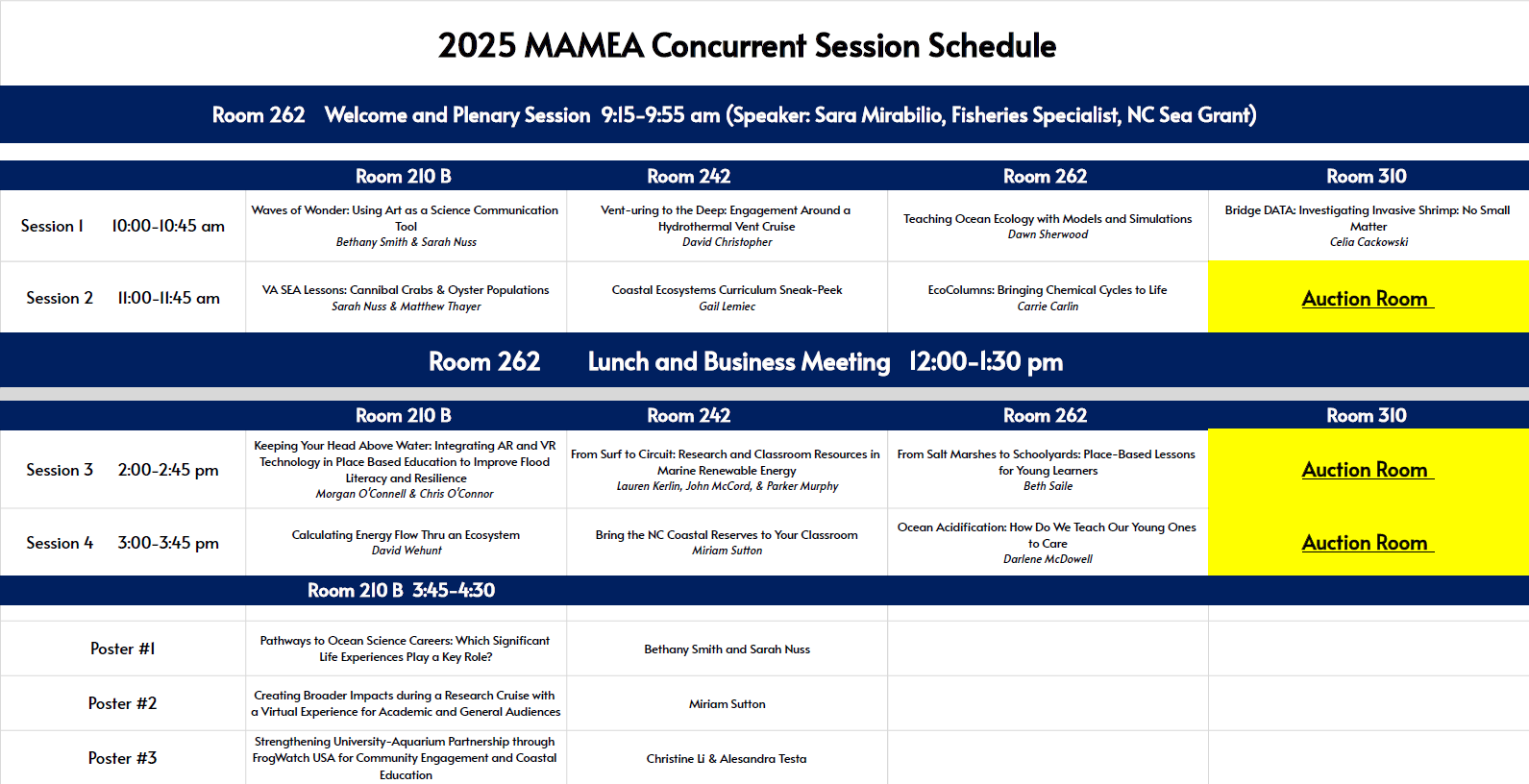
Waves of Wonder: Using Art as a Science Communication Tool
Bethany Smith & Dr. Sarah Nuss, Virginia Institute of Marine Science
This session will highlight emerging programs at The Batten School & VIMS that foster collaborations between art and science, enabling more imaginative expressions of scientific concepts that can resonate with previously unreached audiences. Program highlights include an artist-in-residence program, a student near-peer art and science exchange, and youth summer camp science exploration through art. Through cross-disciplinary connections between art and science, we are capitalizing on the creativity that is inherent in both disciplines to create novel methods of science communication and learning that open doors to new audiences. All audiences.
Vent-uring to the Deep: Engagement Around a Hydrothermal Vent Cruise
David Christopher, Delaware Sea GrantIn April 2025, a group of faculty, staff, and students from the University of Delaware took part in a research cruise to the East Pacific Rise to study hydrothermal vents. In this session, participants will learn about this exciting expedition and about how the team engaged school students and the public both during and after the cruise. All audiences.
Teaching Ocean Ecology with Models and Simulations
Dawn Sherwood, Henrico County Public Schools (Virginia)Models and simulations can help illustrate cause-and-effect relationships in nature, and are integral to 3D science teaching methods. In this interactive session, participants will engage in inquiry-based simulations, role-playing, and modeling activities that explore several topics related to ocean ecology. These include predator-prey relationships in marine ecosystems, how human-environmental interactions affect the health of ocean habitats, and paths to sustainability. Activity formats include a role-playing simulation on carrying capacity, an interactive history of ocean use, and a visual demonstration of supply and demand of ocean resources.
Participants will learn ways to incorporate these modeling and simulation activities into instruction in classrooms and informal sites. They will also be able to identify how the presented hands-on activities use 3-D learning strategies, and how the activities can be used and adapted to reach all kinds of learners. Receive lesson plans and background materials aligned with national and state learning standards for science, social studies and mathematics. Target audience: middle school teachers, high school teachers, informal educators.Bridge DATA: Investigating Invasive Shrimp: No Small Matter
Celia Cackowski, Virginia Institute of Marine ScienceLooking for a classroom activity that ties in human impacts on ecosystems, movement of aquatic organisms through global shipping channels, and methods scientists use to track species across the globe? In this hands-on workshop we'll use the Global Biodiversity Information Facility (GBIF) database to follow the path of the Oriental grass shrimp (Palaemon macrodactylus) over several decades. Participants will then work in teams to graph records by year and answer a series of questions based on the results. Target audience: middle school teachers.
-
VA SEA Lessons: Cannibal Crabs & Oyster Populations
Dr. Sarah Nuss & Matthew Thayer, Virginia Institute of Marine ScienceGet your students hooked on Chesapeake Bay science with two hands-on, data-driven lessons featuring the Bay’s iconic blue crabs and oysters! Join VIMS educators as they share VA SEA grad student lessons based on their research. Investigate blue crab cannibalism with a prey density experiment and dive into climate-driven changes in oyster populations using real survey data and histograms. Engaging, standards-aligned, and classroom-ready! Target audiences: middle school teachers, high school teachers, informal educators.
Coastal Ecosystems Curriculum Sneak-Peek
Gail Lemiec, North Carolina Aquarium at Fort Fisher
Join the NC Aquarium at Fort Fisher to pilot some new lesson plans based on conserving coastal ecosystems. These lesson plans will be added to the Coastal Ecosystems K-8 STEAM-based curriculum that is currently being developed by the NC Aquariums. This session will provide participants with hands-on activities and copies of lesson plans and access to educator resources on the Aquarium website. Participants will have the opportunity to offer feedback on the lesson plans. Lesson topics are appropriate for elementary and middle grade educators. Target audiences: elementary school teachers, middle school teachers, informal educators.
EcoColumns: Bringing Chemical Cycles to Life
Carrie Carlin, Hanover County Public Schools (Virginia)This is a project based learning lab that allows students to model biogeochemical cycles within a terrarium. Students then take this hands on approach and relate it to real world examples, like ocean acidification, change in climates, etc. Target audiences: middle school teachers, high school teachers.
-
Keeping Your Head Above Water: Integrating AR and VR Technology in Place Based Education to Improve Flood Literacy and Resilience
Morgan O'Connell, Chris O’Connor, & Erin Moran, UNCW MarineQuestJoin UNCW MarineQuest as we explore a unique program created for a collaborative research grant and implemented during the 2024-2025 academic year. Classroom lessons were created to build flood literacy in students, at their schools, while simultaneously targeting NC Science and Engineering Principles for 4th grade. This was achieved through the use of 3D topographic boxes, virtual reality (VR) field trips, an augmented reality (AR) sandbox, and a water level sensor maker challenge. During this session, we will create a model of an urban watershed from a topographic map, analyze the effect of topography on flooding with an augmented reality sandbox, and go on a virtual field trip of a Wilmington area watershed (Burnt Mill Creek). You will leave knowing how to access FEMA maps, create 360° VR field trips and gain confidence in your ability to promote flood literacy. All audiences.
From Surf to Circuit: Research and Classroom Resources in Marine Renewable Energy
Lauren Kerlin, John McCord, & Parker Murphy, Coastal Studies InstituteJoin staff from the Coastal Studies Institute to explore cutting-edge research and technological advancements in marine renewable energy. This session will highlight the research priorities of the North Carolina Renewable Ocean Energy Program and the Atlantic Marine Energy Center, while also showcasing classroom-ready educational resources developed by CSI. Participants will leave with lesson plans and hands-on activities that bring wave energy conversion and current energy conversion technologies into the classroom, as well as all-new materials introducing waves as a renewable energy source, demonstrating how waves are measured, and connect these measurements to real-world applications in wave energy device design and deployment. All audiences.
From Salt Marshes to Schoolyards: Place-Based Lessons for Young Learners
Beth Saile,How do you bring salt marshes and other coastal ecosystems into the classroom? I developed a five-lesson, place-based curriculum for upper elementary students that highlights carnivorous plants, native species, longleaf pine savannas, and salt marshes. This lightning talk zooms in on the salt marsh lessons, showing how inquiry-based, hands-on activities can connect kids directly to the marine environment.
I’ll share strategies rooted in Universal Design for Learning (UDL), cross-curricular integration, and citizen science opportunities that help students of all abilities engage with coastal science. I’ll also present findings from a Wilmington teacher focus group on how educators see these lessons fitting into their classrooms—their enthusiasm, their challenges, and their practical suggestions.
Participants will walk away with fresh, classroom-ready ideas for teaching salt marsh ecology, tools for making lessons accessible to neurodiverse learners, and a clearer sense of how teachers themselves view the possibilities of place-based marine education. All audiences.
-
Calculating Energy Flow Thru an Ecosystem
David WehuntFollowing Predator/Prey interactions, students will calculate the flow of energy through an ecosystem. This can also determine the health of the ecosystem by calculating population size of each species. Target audiences: middle school teachers, high school teachers, informal educators.
Bring the NC Coastal Reserves to Your Classroom
Miriam SuttonNorth Carolina is home to 10 Coastal Reserves, from Corolla in the north to Sunset Beach on our southern border. Participants will be introduced to each of the NC Coastal Reserves, including: Currituck Banks, Kitty Hawk Woods, Emily & Richardson Preyer Buckridge, Buxton Woods, Rachel Carson, Permuda, Masonboro Island, Zekes Island, Bald Head, and Bird Island. Video clips and images highlighting the unique features of each location will transcend participants on a virtual field trip through the Reserves, culminating with the seasonal transitions in the flora and fauna observed throughout one of the Coastal Reserves. A Virtual Field Trip (VFT) curriculum, developed by Science by the Sea®, will also be reviewed with participants and information on scheduling a free VFT for their classroom will be provided. All audiences.
Ocean Acidification: How Do We Teach Our Young Ones to Care
Darlene McDowellDefine ocean acidification and why this invisible threat should matter to everyone, but especially our young people. We will explore using diagrams that show how CO2 is absorbed by the ocean and the chemical equation of these devastating changes. After focusing on the causes of ocean acidification and the role of human-caused CO2 emissions, effects on marine life will be explained along with economic and ecological impacts. Conclusion will come with labs and hands-on activities to complete with your students to hopefully send them a message and prompt them to take action! Target audiences: middle school teachers, high school teachers.
-
Pathways to Ocean Science Careers: Which Significant Life Experiences Play a Key Role?
Bethany Smith & Dr. Sarah Nuss, Virginia Institute of Marine Science
Pathways to careers in ocean science are less studied than other STEM fields, and diversity is lacking in most ocean science fields. The results of this pilot study examine the life experiences leading to a range of ocean science careers, and the barriers participants encountered that may affect representation. All audiences.
Creating Broader Impacts during a Research Cruise with a Virtual Experience for Academic and General Audiences
Miriam Sutton, NC Coastal Reserves
"Creating Broader Impacts during a Research Cruise with a Virtual Experience for Academic and General Audiences" is a curriculum that guides students (middle grades/high school/college) and general audiences through the scientific methods and technologies incorporated during a 2-week investigation focused on microbial oceanography. The curriculum allows students to work independently or in teams to complete the activity as a stand-alone lesson or within a marine science curriculum. Photo-journals and videos from the PUPCYCLE* Research Cruise engage students as they explore the relationship between phytoplankton blooms and ocean upwelling cycles. Students explore physical and biological concepts, aligned with science standards and describe the responses of phytoplankton during various phases of coastal ocean upwelling. A certificate of completion is available for download after completion of the activity. Target audiences: middle school teachers, high school teachers, college instructors, informal educators, researchers (scientific or educational).
Strengthening University-Aquarium Partnership through FrogWatch USA for Community Engagement and Coastal Education
Christine Li & Alesandra Testa, UNC Wilmington Department of Environmental Sciences
The North American Coastal Plain has been identified as a hotspot for accelerated sea level rise and was classified as a biodiversity hotspot in 2016 (Reed et al., 2015; Miller et al., 2013). Anurans have been important in coastal communities and wetland ecosystems, both prey and predator. Over 2,000 amphibian species are currently threatened with extinction, and many more are experiencing sharp population declines around the world. This alarming trend may be a sign of deteriorating wetland health, water quality, air pollution, and climate change. The quality of water supply in coastal and island regions is at risk from rising sea level and changes in precipitation. The amount of rainwater and water quality are crucial indicators that influence amphibian diversity and populations. It is essential that scientists understand the scope, geographic scale, and cause of these declines.
The University of North Carolina Wilmington Department of Environmental Sciences engages undergraduate and graduate students through active and community-based research, education, and outreach. In Spring 2025, we developed a new program featuring coastal-themed citizen science projects. We collected rainwater data by following a national citizen science protocol, CoCoRaHS. CoCoRaHS is a grassroots volunteer network of backyard weather observers of all ages and backgrounds working together to measure and map precipitation in their local communities. Additionally, Frog Watch USA, another national citizen science project, can be utilized to track anuran population ranges. Our project aims to combine these citizen science protocols to enhance STEM education and increase civic engagement in data collection. All audiences.